Priorities & Programmes

Joint Health and Wellbeing Strategy for Nottingham City (2025 – 2028)
The Place-Based Partnership holds delegated responsibility from the Health and Wellbeing Board to oversee the delivery of the Joint Local Health and Wellbeing Strategy, a statutory responsibility of the Board.
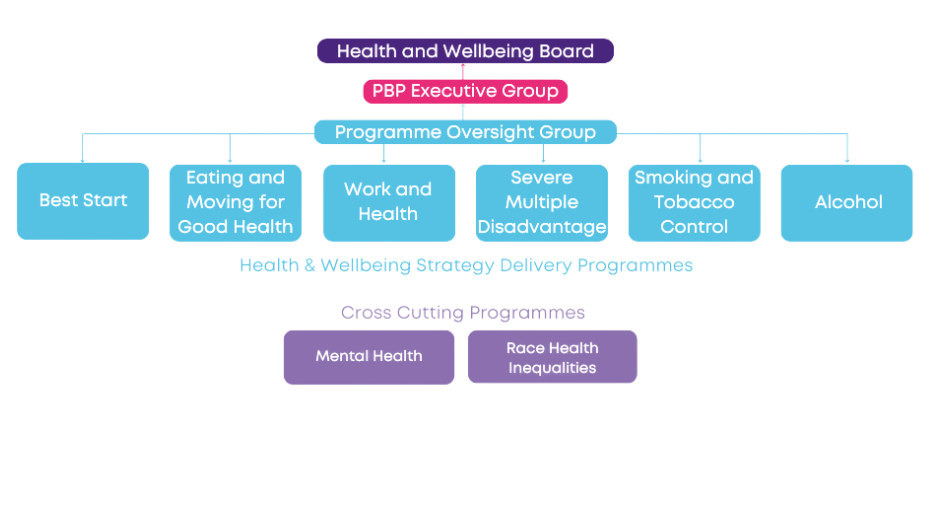
Building on the success of the Joint Local Health and Wellbeing Strategy (2022-25), the refreshed Joint Local Health and Wellbeing Strategy (2025-2028) continues three of the previous Strategy’s priorities, as well as three new priorities. Race Health Inequalities and Mental health continue as cross-cutting programmes.
| Continuing Priorities (2022-28) | New Priorities (2025-28) |
|---|---|
| Smoking and Tobacco Control | Best Start in Life |
| Eating and Moving for Good Health | Reducing Alcohol Related Harm |
| Severe and Multiple Disadvantage | Work and Health |
| Cross Cutting Programmes (2022-28) |
|---|
| Race Health Inequalities |
| Mental Health |
The new Joint Local Health and Wellbeing Strategy (2025-2028) builds on the previous Strategy, continuing to focus on improving health and wellbeing and reduce health inequalities across Nottingham City, through addressing the wider determinants of health and enabling people to make healthy decisions.
Read the previous strategy in full here: JLHWS 25+
You can read the latest delivery plans for the priorities on the links below:
- Smoking & Tobacco Control
- Best Start in Life
- Eating & Moving for Good Health
- Reducing Alcohol Related Harm
- Severe & Multiple Disadvantage
- Work & Health
- Race Health Inequalities
- Mental Health
Building on the previous Strategy, we are continuing our programmatic, partnership approach to delivery, with programme leads supported by partnership delivery teams comprising colleagues from across partner organisations. Programme leads report progress into the Programme Oversight Group, which is supported by the PBP Executive Team. A delivery update report is provided to the Health and Wellbeing Board twice a year.
Successes from the previous Strategy
The partnership approach taken to the Joint Local Health and Wellbeing Strategy (JLHWS) 2022-25 had a positive impact on the health and wellbeing of our local population across the priority areas.
The JLHWS 2022–2025 set out a bold vision to improve health and wellbeing and reduce health inequalities of the population of Nottingham through addressing the wider determinants of health and enabling people to make healthy decisions. Working across sectors and organisations, these programmes have moved beyond traditional siloed working, bringing together a wide range of partners to design and deliver more coordinated and targeted interventions that respond to the needs of Nottingham’s communities. Achievements include:
Smoking & Tobacco Control
- Smoking rates in Nottingham reduced by almost 33%, with 19.5% of the population recorded as smokers in 2022, reducing to 13.1% in 2025.
- In this time, over 2,600 people in Nottingham City successfully quit smoking.
- There was just under a 25% reduction in pregnant women record as being smokers at time of delivery (12.1% in 2023/24 to 9.1% in 2024/25).
- Enforcement led to seizure of 22,800 illicit vapes and 5,500 packs of illicit tobacco.
Eating and Moving for Good Health
- 3,300+ adults and children were supported through weight management services.
- When compared with the national average, there was a faster reduction in rates of Year 6 children who are overweight or living with obesity (2.4% vs 0.4% percentage point reduction nationally)
- 1,700+ people participated in physical activity sessions through Travel Well programme.
- Families reported better eating habits, reduced sugary drink consumption, and increased physical activity.
Financial Wellbeing
- Achieved £12.8 million income gains for residents in 2023 through advice services.
- Secured Real Living Wage commitments from key partners (e.g., Nottinghamshire Healthcare NHS Foundation Trust, Nottingham CityCare).
- Social Prescribing Financial Advice Link Worker project delivered tangible financial and wellbeing benefits.
- Targeted training improved frontline professionals’ confidence and skills in supporting citizens with money issues.
- Raised awareness of gambling-related harm and promoted numeracy and financial capability initiatives.
Severe and Multiple Disadvantage (SMD)
- 334 people experiencing SMD benefiting from specialised 1:1 support from Changing Futures Navigators, improving engagement with preventative care and support from across the system, improving outcomes.
- Significant reductions in offending, substance use, stress and anxiety, self-harm, and overall severity of needs as well as improvements in mental and physical health, selfcare, economic wellbeing, use of time and social networks following a period of between 8 months and 1 year in receipt of support.
- Significant reductions in rough sleeping, with 32% of beneficiaries with experience of sleeping rough prior to Navigator interventions, 18% (on any occasion) whilst on service, and 6% following discharge.
- Substantial reduction in the use of urgent and emergency healthcare interventions by people in receipt of support from a Navigator, including presentations at A&E, days spent in in-patient psychiatric care, and in-patient acute care
- Our SMD Programme won ‘Integrated Care Initiative of the Year’ at the Heath Service Journal Awards 2025!

Read our previous reports here:
- November 2025
- May 2025 (JLHWS 2022-25 Final Delivery Report)
- September 2024
- March 2024
- November 2023
- July 2023
- March 2023
- November 2022
- July 2022
Executive Led Programmes
In addition to the programmes focused on improving health outcomes for Nottingham city citizens, leaders of the PBP are developing a series of Executive Led programmes.
The Nottingham City PBP is part of the Nottingham and Nottinghamshire Integrated Care System (ICS).
We will work together to create happier, healthier communities
and reduce the gap in healthy life expectancy across
Nottingham city.