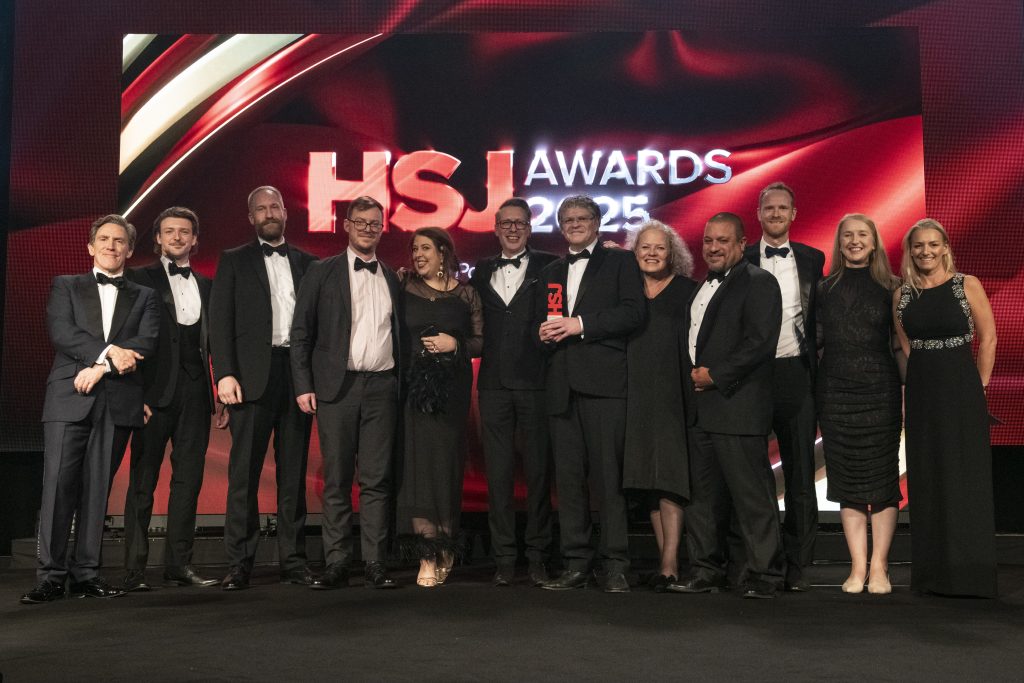
Nottingham City Place-Based Partnership Wins HSJ Award
We are proud to announce that the Nottingham City Place-Based Partnership (PBP) has won Integrated Care Initiative of the Year at the HSJ Awards 2025, recognising our innovative programme supporting people experiencing Severe and Multiple Disadvantage (SMD). This award is a powerful endorsement of our collaborative, place-based approach and the positive impact partners are having on the lives of some of Nottingham’s most disadvantaged residents.
Picture of colleagues who attended the award ceremony with the award and host Rob Brydon.
People who experience SMD face extreme and long-standing health inequalities. Many encounter a cycle of crisis, decline and repeat service use, resulting in significant demand, resource pressures and workforce challenges across health and care systems.
Over the last five years, the PBP has brought together a wide and active collaboration of colleagues from across the system – including people with their own lived experience – to design, implement and deliver a sustainable, place-based model of support for people experiencing SMD.
Each year the SMD programme has been successful in stopping the revolving door of the same services spinning for hundreds of people, helping them to recover, sustain tenancies and rebuild their lives, reducing their reliance on emergency healthcare. The impact on health and care settings is also significant, with an average 75% reduction in hospital admissions and 65% reduction in A&E attendances for people receiving specialist support after three just months.
Thank you and huge congratulations to all our partners, especially those with their own living or lived experience of SMD, who are so integral to our programme. This work would not be possible without the hundreds of people across our SMD partnership who consistently go above and beyond every day to make a difference to people’s lives.
Notes:
People experiencing severe and multiple disadvantage have overlapping experiences of homelessness, problematic substance use, mental-ill health, domestic and sexual violence and/or abuse, and victimisation or offending.
Starting strong: SMD Active Together
What better way to begin a brand-new partnership than by coming together as a team for the Robin Hood Half Marathon.
The whole event epitomises the team spirit we aim to foster in our work supporting people experiencing severe and multiple disadvantage (SMD) and was the perfect place to launch SMD Active Together – a partnership all about strengthening relationships, raising awareness and supporting each other’s wellbeing so we can continue to do our best for people.
As a collective, we represented a wide range of organisations throughout Nottingham all of which work to support people who face multiple disadvantage. Our team included colleagues representing CityCare services, the Changing Futures Programme, the Practice Development Unit (PDU), Nottinghamshire Healthcare Trust, Nottingham University Hospitals, Emmanual House, Nottingham CVS, The Friary, Public Health, Adult Social Care, and the Nottingham and Nottinghamshire Integrated Care Board.
It was a true team effort from the runners completing the course to the volunteers keeping everyone on track, it was a fantastic day filled with cheers, hugs, smiles and even the sun which started to shine as people crossed the finish line.
It’s fair to say that the Robin Hood Half Marathon has set the tone for what’s to come. Even though there are sore legs and voices today we start the week with a new energy for what we can achieve as a collective. Thanks to everyone who took part yesterday including friends and family who came to support and cheer us on.
Know Your Numbers Week
Know your Numbers Week 2025
Know Your Numbers Week 2025 launches across Nottingham City ! Running from 8–16 September, this year’s campaign is set to be bigger and better than ever.
Thanks to the fantastic support from partners and communities, the campaign has been extended by two extra days, giving even more people the opportunity to get their blood pressure checked and take charge of their health.
Over 100 organisations taking part
This year, more than 100 organisations are joining forces across Nottingham City to support the campaign. From community groups to health professionals, the collaboration shows the strength of commitment to raising awareness about the importance of knowing your blood pressure.
Your support makes a real difference — helping us reach communities, engage the public, and improve health outcomes across our city.
Campaign packs and resources
To make it easy to get involved, a full campaign pack is being shared with partners, including:
Posters and leaflets (downloadable and printable)
A presentation slide for screens and waiting rooms
Throughout the week, communities can take part in a wide range of activities, including:
Radio interviews and podcasts
Community health events and awareness sessions
Cooking demonstrations and healthy BBQs
Blood pressure checks at local events and venues
Organisations including Nottingham Forest Community Trust, Notts County Foundation, Faza Radio, Halfords, Thriving Nottingham, and many community groups are supporting the campaign, helping us reach as many people as possible.
We’re delighted to have the support of Clive Foster MBE, Windrush Commissioner, and Margaret Kelly MBE, Olympic swimmer, as campaign ambassadors this year. Their voices, alongside those of Nottingham City Councillors and local health professionals, will help shine a spotlight on the importance of blood pressure checks.
We’d also like to thank Nottingham City Councillors Coral Jenkins, Helen Kelsli, Neghat Khan, and Linda Woodings for sharing their special messages with our city residents. Your support is invaluable in helping us reach and inspire local communities.
Podcasts available
You can tune into podcasts hosted by Community Pharmacy’s Mike Jones and Kirsten, shining a spotlight on the importance of blood pressure checks:
Both episodes are a fantastic way to learn more about the campaign and hear first-hand why checking your blood pressure is such an important step towards better health.
Videos available
Our Know Your Numbers 2025 videos are ready to use and share!
You can upload them on social media, play them on waiting room TV screens, or even share via WhatsApp with friends and colleagues. There are nine videos in total, all available on our dedicated YouTube channel: Know Your Numbers campaign 2025 – YouTube.
The videos feature messages from community leaders, health professionals and ambassadors, including:
Margaret Kelly MBE, Olympic swimmer, with Dr Emma Sawyer (Nottingham City GP), Mandip Bassi (Nottingham City Pharmacist) & Jamie Robson (Thriving Nottingham)
Clive Foster MBE, Windrush Commissioner, with Layo Ogunremi (Nottingham City Pharmacist), Eldeen Thorne (Thriving Nottingham) & Dr Olawale (Nottingham City GP)
Cllr Coral Jenkins – message to Nottingham’s Black community
Cllr Helen Kalisi – message focused on falls prevention
Cllr Neghat Khan – message to Nottingham’s Asian community
Cllr Linda Woodings – message for business owners, encouraging time for health checks
Clive Foster MBE – short message
Dr Emma Sawyer – short message
Mandip Bassi – short message
These videos are a fantastic way to spread the word and encourage more people across Nottingham to Know Their Numbers.
Thank you for your support
Together, we can make this year’s Know Your Numbers campaign the biggest yet. By encouraging people to check their blood pressure, we can help more people in Nottingham take action to live healthier, longer lives.
Keep an eye out for more updates and resources in the coming days — and most importantly, don’t forget to Know Your Numbers!
Dr Andrew Foster: Introducing the Nottingham & Notts Primary-Secondary Care Interface Partnership
The Primary Secondary Care interface group has been working since 2021 to improve the way that staff at Nottingham University Hospitals and those working in General Practice work together.
Their focus is to improve patient care and clinical outcomes by strengthening relationships between these two groups of staff by building and trust and taking real action to change behaviours and processes that can complicate patient care and damage this partnership.
The group has delivered tangible changes, and the work of the group has been recognised locally and nationally with other organisations learning from their experience and working to create similar projects.
Key Achievements
The group has generated around 90 projects aimed at improving the interface between primary and secondary care. As a result, many of those things which have historically caused additional work and frustration should now happen much less often. Notable examples include:
Hospital discharge summary audit – Over 7,000 discharge summaries have been audited to understand the type and scale of inappropriate transfer of work from secondary to primary care.
Co-produced presentation outlining five asks that improve patient experience at the interface
The Five Asks Scheme 1. Communicate clearly and concisely. Where actions are required by the patient or GP, make this clear and easy to identify in all correspondence. 2. Refer a patient to another speciality within NUH where this relates to the original problem, or a directly related medical condition, rather than asking the GP. 3. Follow up the results of tests NUH have undertaken, informing the patient and completing any actions, as required. 4. Issue a fit note, wherever appropriate for the full duration needed. 5. Provide patients with prescriptions for new or altered medications when seeing them in an NUH outpatient setting
Primary Care Presence in NUH Inductions – GPs now participate in junior doctor and consultant inductions, providing insights into the Primary Care perspective and fostering a culture of collaboration from the outset of their careers.
Jointly agreed letter templates regarding inappropriate request to GPs – Templates agreed with and supported by NUH leadership to support General Practice to correct unsuitable demands.
Primary-Secondary Interface event June 2024 – Attended by GPs and Consultants and supported NUH and the LMC to increase engagement with the work of improving relationships.
NUH Fix It WhatsApp Group –
No more “repeat chest Xray in 6 weeks” – An often-cited frustration in General Practice. Hospital staff now take responsibility for arranging repeat chest x-rays following discharge.
The Interface Group categorize their wide-ranging activity across six domains (Culture & Relationships, Continuous Improvement, Clinical Integration, Digital Integration, Training and Development and Communications) and have a pipeline of future improvement plans.
How the Primary Secondary Care Interface Group began and evolved
The relationship between Secondary Care clinicians and General Practice is complicated. Many have felt historical frictions worsen in recent years as demands on the system have increased and technology, standardised communication proformas and referral triage processes have increased the distance between the two sectors.
This interface work began in late 2021, as both General Practice and NUH were facing huge pressures due to the COVID19 pandemic. All Nottingham based clinicians share the care of a population experiencing broad challenges including; access to care, worsening outcomes, and health inequalities. The system faces large backlogs of pent-up demand and long waiting lists, a workforce exhausted by pandemic pressures, and significant financial pressures.
A group of NUH consultants, staff and leaders from General Practice began meeting to explore how the two sectors could collaborate and work more effectively together to meet these challenges.
Early discussions in the interface group identified the sense of a deepening “them and us” culture. Initial meetings allowed clinicians from both sectors to express their struggles candidly and acknowledge that they were facing similar and connected issues. This transparency has been crucial in the developing of relationships, trust and a culture of collaboration.
There was a shared recognition that both primary and secondary care were struggling with similar challenges. They became focussed on finding solutions that benefit both sectors and also securing a smoother journey through the system and better outcomes for patients.
Principles
· Don’t duplicate work that is already being undertaken elsewhere in the system
· Seek to satisfy the needs of our patients at their first presentation to healthcare services, whenever possible
· Be open, honest & respectful to each other, recognising that we are all doing our best to meet the needs of our population
· Don’t try to solve everything. Take action that will make a difference to someone: · What we can do in days and weeks rather than in months or years · Doing something is better than nothing · Not everything we try will work
· Don’t ask someone to do something that you should be doing yourself
· Developing an understanding of ‘this patient needs’ and being able to respond regardless of the care setting
Key principals keep the group’s work focussed on delivering meaningful change
A focus on early quick wins allowed the group to build momentum, grow and become an established fixture within the system. The group has expanded to include representatives from NUH clinical and organisational leadership, Nottingham City and South Notts Place Based Partnerships, the ICB Clinical Design Authority and Nottinghamshire LMC.
Representatives from NUH departments and other parts of the system attend meetings to discuss specific issues relating to their part in the interface between primary and secondary care. They meet weekly to discuss challenges and to address issues.
People involved
Nottingham City PBP – Dr Husein Mawji, Dr Andrew Foster, Claire Matthews.
NUH – Dr Mark Simmonds, Dr Alun Harcombe, Dr John Walsh, Tim Guyler, Simon Gascoigne, Kelly Jandrell, John Peach.
Research – Dr Nick Boddy.
ICB – Dr Stephen Shortt, Dr Nicola Jay.
South Notts PBP – Dr Jill Langridge, Dr Aamer Ali, Jacki Moss.
Clinical Design Authority – Dr Jeremy Griffiths.
Local Medical Committee – Dr James Hopkinson, Dr Jen Moss-Langfield.
Regular membership includes individuals with the ability to influence their organisations
A culture of open, honest, informal communication and relationship-building enables an agile approach to making decision and taking action. The work is supported by the NUH integration team who support the structure and governance of the group. This has been essential to balance the open and informal atmosphere with an ability to be organised and impactful.
Primary/Secondary Roadmap
The group has delivered multiple milestones since 2021, these include:
September 2021
Primary/Secondary Care Interface Group established to support the recovery of Long Term Conditions management
October 2021
Explored initial areas of focus including UEC attends and Spirometry
August 2022
Primary Care video incorporated into Junior Doctors Induction
September 2022
Shared Learning Programme commenced (3 year multi disciplinary rolling training programme jointly provided by NUH Heads of Service and Primary Care
November 2022
1st Primary/Secondary Care Working Group with NUH CEO and Primary Care Representatives
November 2022
Spirometry Pilot Launch
November 2022
Flu outreach pilot commenced providing opportunistic vaccinations to patients attending routine hospital appointments
January 2023
Established a Written Communications Sub Group to look at clinic letters/discharge letters/waiting list communications/TTO audit
January 2023
NUH CEO writes to all GP practices to share the Trust’s first People First Report
May 2023
2nd Primary/Secondary Care Working Group with NUH CEO and Primary Care representatives
August 2023
Written Communications Group engagement with 45 specialties to feedback issues raised by interface group and identify opportunities for improvement
September 2023
Audit of 7,000 TTOs to review what is being asked of GPs
October 2023
Reinforcement of clinical and professional behaviours enabling improvement of the interface
November 2023
Primary/Secondary Care update to NUH Trust Leadership Board
December 2023
NUH Fix IT Pilot commenced
January 2024
Primary/Secondary Care Interface Update to NUH Trust Board
January 2024
Echo on ICE business case approval
January 2024
GP/Consultant Twinning Scheme – 20 NUH Consultants and 20 GPs shadowing one another to gain broader understanding of each other’s environments
May 2024
Primary/Secondary Care Working Group meeting with NUH CEO and Primary Care Representatives
May 2024
NUH Chief Executive writes to all GP practices
May 2024
Raising the profile of this work locally and nationally through various routes including ICB, NHS England and NHS Confederation
July 2024
Primary/Secondary Care Engagement Event
Learning from the Interface Group
The impact of this work has led to increased interest from clinical specialties keen to engage with the interface group. There have been discussions exploring the establishment of groups to improve the interface between other system partners such as Nottinghamshire Healthcare Trust and East Midlands Ambulance Service. The initiative has gained recognition at a national level, with group leaders being asked to share learning from the Nottingham experience through the NHS Confederation.
Key learning points
Building Relationships and Trust: Regular informal meetings where leaders create an open and safe culture enabling representatives from both sectors to engage in candid discussion about mutual concerns.
Adaptability and Flexibility: Being open to change and to challenge established norms, behaviours and embedded processes.
Audit activity and use data: The group audited over 7,000 discharge summaries from NUH to understand the type and scale of work transfer from secondary to primary care, such as requesting further tests and referrals. This evidence added credibility to calls to change processes and behaviours.
Commitment from senior leaders: Senior clinical and executive leaders from both sectors champion the work of the group with colleagues. Leaders need to have sufficient credibility and influence with colleagues to make the argument for change.
Support with governance and structure: To ensure that meetings are productive and actions are completed. The NUH interface team provide project management to ensure that projects are delivered and meetings function effectively.
Celebrating success of primary / secondary care collaboration
More than 80 projects aimed at improving the way primary and secondary care work together have now been completed, with lots more on the way.
Better integration between consultants in departments across Nottingham University Hospitals (NUH) and GP Practices in South Notts and Nottingham City is helping to reduce unnecessary workload shift and improve communication and understanding between primary and secondary care.
Last month, consultants, GPs and other health partners came together for an event hosted by Notts LMC to celebrate the success of the integration work to date, raise awareness and hear the audience’s views about how further improvements can be made.
Working together helped build mutual trust between consultants and GPs, giving each a greater understanding about the daily challenges they faced and how small changes could make a huge difference to the efficiency and effectiveness of each other’s daily work.
Quick wins
The integration work first started informally in September 2021 during the Covid-19 pandemic. From an initial focus on ‘quick wins’, such as simplifying communication and greater use of internal hospital referrals. the project has grown considerably. There are now weekly meetings involving NUH, GPs, Notts LMC and the Place-based Partnerships (PBPs), in addition to task and finish groups tackling specific issues and active, live problem-solving.
The work here in Nottingham is ahead of the game compared to many Trusts around the country with the volume of collaborative work ongoing with primary care.
So much so, it is being held up as an exemplar nationally.
In May, Husein Mawji, GP & Clinical Director, Nottingham City PBP and Mark Simmonds, NUH Deputy Medical Director were invited to present details about the integration work through the NHS Confederation. This has already prompted numerous contacts from colleagues from NHS trusts across the country eager to find out more.
For more information, contact Kelly Jandrell, Integration Project Lead at NUH at kelly.jandrell@nhs.net
Local Routes to Change: Racial Health Inequalities in Nottingham and Nottinghamshire
As a Place-Based Partnership, we’re committed to addressing inequalities and ensuring equitable access to healthcare for all. Partners working as part of our Race Health Inequalities Programmes have been working to address health disparities in Nottingham city, bringing together professionals from the NHS, local government, voluntary sector and community leaders.
Over the past three years, the team have been working to tackle inequalities in health outcomes experienced by minority ethnic communities – a priority that’s importance was further propelled by the disproportionate impact the COVID-19 pandemic had on minority ethnic communities and increased amplification and awareness of systemic racism, as a result of the Black Lives Matter movement.
Since the programme’s inception the group has successfully led and advised on a range of initiatives, including the development of vaccination centres in faith-based community settings, the roll out of community-based initiatives that have targeted health and wellbeing support to diverse communities, as well as providing advice and support Ockenden’s independent review of maternity services at Nottingham University Hospitals.
The Race Health Inequalities Maturity Matrix developed under the stewardship of the programme is helping organisations across Nottingham and Nottinghamshire to improve their cultural competence and responsiveness and address structures and processes that can exacerbate inequalities. This work has received national recognition but signifiesy just the beginning of our work.
The Race Health Inequalities Report, ‘Local Routes to Change’ is a culmination of the voices of people who attended Nottingham’s first ever Race Health Inequalities Summit in May 2023 and the community workshops that followed. It acts as a call to action for what is needed next to address health inequalities experienced in maternity care and mental healthcare but also the focus that is needed to tackle systemic issues which prevent minority ethnic communities from experiencing more equitable health outcomes.
The report identifies that there is more to be done to creating positive change. With collective action and strong leadership, lasting change is possible. We can create a healthier, more equitable future for all.
Seeking expressions of interest to lead Race Health Inequalities programme.
The Nottingham City Place-Based Partnership is seeking expressions of interest for 2 x programme leads to take on joint leadership of the PBP’s Race Health Inequalities programme. The time commitment is approximately 1-2 days a month.
Location: Nottingham / virtual
Remuneration: For discussion
Deadline for expressions of interest:Extended until 10th March
Why should you apply?
Over the last 3 years the Race Health Inequalities programme has brought together PBP partners and community leaders to work together to take a strategic approach to address health inequalities experienced by minority ethnic communities in Nottingham City. The group has successfully led and advised on a range of initiatives, including the development of vaccination centres in faith-based community settings, the roll out of community-based initiatives that have targeted health and wellbeing support to diverse communities, as well as providing advice and support Ockenden’s independent review of maternity services at Nottingham University Hospitals.
The Race Health Inequalities programme is responsible for the development of the Race Health Inequalities Maturity Matrix which is helping organisations across Nottingham and Nottinghamshire to improve their cultural competence and responsiveness and address structures and processes that can exacerbate inequalities. The matrix was recognised nationally at the Health Service Journal Awards 2023, as a finalist in the NHS Race Health Equality category.
The programme was also responsible for the first ever Race Health Inequalities Summit in Nottingham, held in May 2023, bringing together over 200 people representing different communities and organisations in Nottingham. The Summit report, ‘Local Routes to Change’, and its resulting recommendations act as a call to action for what is needed next to address health inequalities experienced in maternity care and mental healthcare.
Despite the work of the RHI partnership, race health inequalities are still stark. In Nottingham, Black and Asian patients being twice as likely to be diagnosed with diabetes than white patients; and Black and patients from a mixed ethnic group three times more likely than white patients to be diagnosed with prostate cancer. Access to services is still an area of concern with Asian and Black patients 37% less likely than white patients to attend A&E and 35-40% less likely than white patients to receive primary care.
While the programme has made inroads, there is still much more to be done to reduce health inequalities experienced by minority ethnic communities. Working alongside partners in the Race Health Inequalities Steering group, this role provides a unique opportunity to make a difference to the lives of people from minority ethnic communities in Nottingham City.
How to apply
If you are interested in taking on a leadership role with the opportunity to bring together partners to influence and challenge the way in which the health and care system works for people from minority ethnic communities, please send a copy of your CV and a short covering letter explaining why you are interested in the role to rich.brady@nhs.net.
Leadership responsibilities
Provide programme leadership for PBP programme priority to reduce race health inequalities in Nottingham City.
Chair the monthly Race Health Inequalities Steering Group comprised of community representative and representatives from PBP partner organisations.
Ensure effective involvement and meaningful engagement with people from ethnically diverse communities to inform approaches to reduce health inequalities.
Engage in wider system forums to identify and support knowledge exchange opportunities.
Foster relationships with system leaders to ensure ethnically diverse voices are heard.
Champion the needs of people from ethnically diverse communities in Nottingham City at Nottingham and Nottinghamshire Integrated Care Partnership meetings (bi-annual).
Programme responsibilities
Oversee the delivery of the PBP programme with support from Executive Sponsor, Jules Sebelin and PBP Programme Director, Rich Brady.
Working with the Race Health Inequalities Steering Group, identify opportunities to reduce race health inequalities, adding value to the work of the PBP and its partners.
With project officer support, lead the continued roll out of the Race Health Inequalities Maturity Matrix, supporting implementation across the Nottingham and Nottinghamshire.
With support from NCVS and the PBP Programme Director, oversee programme management processes, including reporting, resource and risk management, and tracking of outcomes / performance information.
Attend and provide bi-monthly highlight reports on programme progress to the PBP Programme Oversight Group.
Represent the Race Health Inequalities Steering Group at PBP Executive Team meetings, as required in agreement with Programme Director.
Other responsibilities
With support from NCVS, undertake engagement events / activities with community groups, building trust between communities and PBP partners to support the overarching programme ambition to reduce race health inequalities.
Be a conduit between PBP partners and community representatives to support the PBP to transition from community engagement to community empowerment approaches.
Seek opportunities for community empowerment to improve health and wellbeing outcomes of people from minority ethnic communities.
Programme Lead Support
Regular support meetings with the Programme Director and Executive Sponsor.
Project support for the roll out of the Race Health Inequalities Maturity Matrix.
We have live Social Prescribing Advice Link Worker Projects across three Primary Care Networks: BACHS, Nottingham City East, Bulwell & Top Valley. Each PCN has their own money advice worker, employed by a welfare advice service in the city but embedded within the PCN and working through a social prescribing model.
The value of welfare advice in primary care was recognised as far a back as 1985: Jarman, B. (1985) ‘Giving advice about welfare benefits in general practice’. There have been several projects like this across the UK since, with reports showing significant health impacts. So, we are delighted to have this off the ground in Nottingham. The difference being made to the lives of individuals is vast.
One example is below:
This gentleman was extremely socially isolated. He had a long history of substance misuse and PTSD due to childhood trauma. He had an industrial injury meaning he was unable to use his left arm and walked with a stick due to sciatica. He had no trust in services, felt let down by everyone. He was in serious financial difficulty leading to a worsening of his mental health.
The money advice worker (the first person to visit his home in a long time) discovered he had numerous debts, many unopened letters and his welfare benefits had stopped. She subsequently managed to persuade him to leave the house and go to the advice centre, securing him food and fuel vouchers to tide him over while they worked through the emergency situation. She began working on his welfare benefits and debts that resulted in his Personal Independence Payments (PIP) being reinstated, and at a higher rate than it had previously been. He also received £7,700 in backdated payments. Manageable repayments were negotiated with the creditors for the gentleman’s debts. And, once he received his backdated PIP award, he was able to pay off all his priority debts.
Because of the support he received the gentleman reported his mental health improved significantly. At the final meeting, he reported that, ‘a massive weight had been lifted’. He said he’d felt they ‘cared about him as a person’, explaining he would probably have slipped back in to using drugs had he not got the help. He now tries to leave the house every day and is able to buy ‘nice food’ for him and his cat.
As well as the financial gains, we measure wellbeing impact using the ‘MyCaW’ tool. Initially, the gentleman’s self-reported scores were at the highest levels for both their financial concerns and general wellbeing. By the end, their score for financial concerns had reduced to zero, and the general wellbeing score reduced by two-thirds.
If you would like to find out more please contact: : Emma Bates, Lead for Nottingham Financial Resilience Partnership: 01332 460466; emma@financialinclusionsupport.co.uk
Manage Consent
To provide the best experiences, we use technologies like cookies to store and/or access device information. Consenting to these technologies will allow us to process data such as browsing behavior or unique IDs on this site. Not consenting or withdrawing consent, may adversely affect certain features and functions.
Functional
Always active
The technical storage or access is strictly necessary for the legitimate purpose of enabling the use of a specific service explicitly requested by the subscriber or user, or for the sole purpose of carrying out the transmission of a communication over an electronic communications network.
Preferences
The technical storage or access is necessary for the legitimate purpose of storing preferences that are not requested by the subscriber or user.
Statistics
The technical storage or access that is used exclusively for statistical purposes.The technical storage or access that is used exclusively for anonymous statistical purposes. Without a subpoena, voluntary compliance on the part of your Internet Service Provider, or additional records from a third party, information stored or retrieved for this purpose alone cannot usually be used to identify you.
Marketing
The technical storage or access is required to create user profiles to send advertising, or to track the user on a website or across several websites for similar marketing purposes.