Newark grandfather and councillor urges others to ‘take a second to prevent a serious illness.’

A Newark grandfather and newly appointed Vice Chairman of Nottinghamshire County Council (NCC) who fought off the flu when he was younger has urged people everyone to get their jab and protect the young and elderly in Newark.

Stuart Wallace, aged 73, has had the jab every year for the past eight years. As a former chair of the adult and social care committee at Nottinghamshire County Council (NCC) he understands all too well how devastating it can be.

Mr Wallace, who has represented the people of Newark East at NCC since 2009 said: “Let’s not forget that flu can be fatal or at the least debilitating. In 1918 around 50 million people around the world died from the Spanish Flu.

“I got flu when I was in my 30s and fit and healthy and it flattened me for two weeks. I’ve never felt so ill. It makes me think now how it would feel for older and vulnerable people who are already unwell if they got it. And it can be easily avoided by getting the vaccine.

It’s takes a second to get the jab and prevent a serious illness.”

The strain of flu alters every winter which is why people are urged to get vaccinated every year.

Councillor Wallace, who has lived in Newark for 18 years before moving to Farndon in 2019 said: “For those people who are exceptionally vulnerable like the elderly or very young, I would encourage everyone to get the vaccine, either as a nasal spray for children or injection for adults.

“I also want all my staff who have face to face contact with the elderly or vulnerable to get the vaccination so that they won’t pass it on to them.”

NCC is providing free flu jabs for frontline workers such as social care staff. This helps protect the most vulnerable people from contracting flu-like illnesses following contact with its staff.

A series of flu clinics are being held at NCC office bases around the county or eligible staff can order a voucher to exchange for a free vaccination at a time more convenient to them.

This is one of the ways NHS and council partners are working together across the Mid-Nottinghamshire Integrated Care Partnership (ICP) this year to focus on vaccinating as many people as possible with the flu jab.

Dr Thilan Bartholomeuz, Clinical Chair of Newark & Sherwood CCG and GP at Abbey Medical Group in Blidworth & Ravenshead said: “Australia, which often predicts the UK winter season, has had a bad flu season. We also know that those with respiratory conditions like emphysema and asthma are a major cause for emergency admissions to hospitals in winter. This is why all GPs across Mansfield, Ashfield, Newark and Sherwood are working together to make protecting our populations against flu our priority this winter.”

People should contact their GP if they qualify for a free flu jab. Even if they are not eligible for a free vaccination they can still book a flu jab at some local chemists or supermarkets for a small charge.

ENDS

If you have any queries about this please contact Kerry Beadling-Barron, Director of Communications and Engagement at Mid-Nottinghamshire ICP on Kerry.beadling-barron@nhs.net
Hundreds of care home workers across Mid-Nottinghamshire are being urged to get the flu vaccination in a new joint campaign

Staff who work with frail and elderly people in care homes across Mansfield, Ashfield, Newark and Sherwood are receiving extra information this year to encourage them to get a free flu jab.

Every year flu causes serious illness and even death. That’s why those over 65, people under 65 with a long term condition, pregnant women and children aged 2-3 are all able to get a vaccination for free from their GP. If the staff who are caring for them also get the flu jab it can greatly decrease their chances of passing it onto their vulnerable patients.

To tackle this, for the first time Nottinghamshire County Council is funding the Nottinghamshire Alliance of Training Hubs to go out and about to care homes to reinforce why it is so important to get the jab and bust some myths along the way. For example some people do not realise that:

  • The flu vaccine cannot give you flu
  • You have to be vaccinated every year as the flu strain changes every year

Lisa Hodgkinson, Independent Care Sector Specialist Nurse at Nottinghamshire Alliance of Training Hubs said: “The response has been fantastic. Just a little bit of information can make a massive difference on people’s perceptions. I have had a big increase in responses to say that people will be having the free flu vaccination.”

Councillor Tony Harper, Chair of Adult Social Care and Public Health Committee at Nottinghamshire County Council said: “We want front line staff to realise how important they are in stopping flu spreading to the most vulnerable members of our community. That’s why we’ve taken this extra step to fund this additional activity and we hope it will mean that more staff choose to get vaccinated.”

This is one of a number of joint projects taking place across the Mid-Nottinghamshire Integrated Care Partnership (ICP). This is a new partnership of NHS providers, commissioners and local authorities who want to create happier, healthier communities across Mansfield, Ashfield, Sherwood and Newark and reduce differences in healthy life expectancy (the number of years that people live in good general health) by three years.

Sessions have been delivered at care homes from September as well as at some key events.

People should contact their GP if they qualify for a free flu jab. Even if they are not eligible for a free vaccination they can still book a flu jab at some local chemists or supermarkets for a small charge.

ENDS

If you have any queries about this please contact Kerry Beadling-Barron, Director of Communications and Engagement at Mid-Nottinghamshire ICP on Kerry.beadling-barron@nhs.net
Kind health workers welcome lonely residents into GP surgery this Christmas

Lonely people in Mansfield can spend Christmas with friendly healthcare staff this year after a local GP surgery decided to open its doors.

The Oak Tree Lane Surgery in Mansfield will welcome anyone that would normally spend Christmas alone to its practice on Christmas Day this year from 9am to 12pm.

This is not the first year the practice will be opening its doors. It also opened last year for Christmas Day and Boxing Day.

Practice Manager Nicola Ryan said: “We know the winter months are very hard for the homeless but it is also hard for vulnerable, isolated and frail people.

“We do not want anyone in our community to spend Christmas alone.

“That is why we are inviting anyone who would be by themselves on Christmas Day to join us for some company and cheer.”

Staff will be providing hot and cold drinks, cakes, crackers a quiz and a game of Bingo.

If anyone would like to donate prizes for the games or a small gift to pass on to visitors they can drop this in at either Oak Tree Lane Surgery or Rosemary Street Health Centre.

ENDS

If you have any queries about this please contact Kerry Beadling-Barron, Director of Communications and Engagement at Mid-Nottinghamshire ICP on Kerry.beadling-barron@nhs.net
Scottish visitors come to Mid-Nottinghamshire to learn lessons about caring for people who are dying and supporting those who repeatedly come to A&E

Care workers from across Mansfield, Ashfield, Newark and Sherwood welcomed visitors from NHS Highland to Ashfield to share learning on caring for dying patients and those who frequent A&E repeatedly.

The group for NHS Highland included Iain Stewart, CEO NHS Highlands, Kate Patience-Quate, Deputy Board Nurse, Kenny Steele, CEO Highland Hospice, and Sian Jones Southside Surgery Inverness.

They met various colleagues representing organisations across Mid-Nottinghamshire who work together on end of life care for people who are dying and to support those who repeatedly turn up to A&E (called High Intensity Service Users). These organisations included:

  • Beamond House Community Hospice
  • Mansfield and Ashfield CCG
  • Mansfield and Ashfield CCG Patient and Public Engagement Committee Chair
  • Mid-Nottinghamshire Integrated Care Partnership (ICP)
  • Nottinghamshire Healthcare NHS Trust
  • Nottinghamshire Hospice
  • Sherwood Forest Hospitals NHS Foundation Trust

The visit was kindly hosted by John Eastwood Hospice in Ashfield and the group was also taken to see the Emergency Department at King’s Mill Hospital and the Ashfield Health and Wellbeing Centre during their two day visit on December 12 and 13.

NHS Highland’s Chief Executive Iain Stewart said: “This has been an extremely useful visit and I was interested to learn about how Mid Notts has integrated their end of life care and how their high intensity service users’ journey has evolved. It has been inspiring to hear how Mid Notts have tackled the challenges they have faced and there is much we can learn from their innovative approach.”

NHS Highland Deputy Nurse Director Kate Patience-Quate said: “Although Highland and Mid Notts are hundreds of miles apart we share a lot of the same challenges around end of life care, especially in service delivery within remote and rural communities. It is encouraging to see such good work being done in Mid Notts and we will look to adopt elements of this approach within NHS Highland.”

Peter Wozencroft, Director of Integrated Care at Mid-Nottinghamshire ICP said: “The last two days have shown that from the Scottish Highlands to Sherwood Forest there are the same issues facing our communities. If we can share our learning, and learn from others, so that all the residents in our communities benefit, then we are happy and proud to do this.”

ENDS

If you have any queries about this please contact Kerry Beadling-Barron, Director of Communications and Engagement at Mid-Nottinghamshire ICP on Kerry.beadling-barron@nhs.net
NOTES TO EDITORS

During the visit the VIPs from NHS Highland met with:

  • Peter Wozencroft, Director of Care Integration and Lorraine Palmer, Head of Care Integration from Mid-Nottinghamshire ICP
  • Ant Rosevear, Assistant Chief Operating Officer, Carly Osbon and Julie Smith, High Intensity Service Users, Deb Elleston, MacMillan Head Nurse for End of Life Care, Dr Ben Lobo, Consultant Physician & Geriatrician Sherwood Forest Hospitals NHS Foundation Trust
  • Caren Rice, Senior Commissioning and Transformation Manager from Mansfield and Ashfield CCG
  • Dr Julie Barker, Mid Notts End of Life Clinical lead, Carl Ellis Head of Service for Mid Notts End of Life Care Together, Sarah McCartney, General Manager, and Julian Broderick, Donna Smith, Head of Urgent Care, Diane Carter, Business Development Manager, Nottinghamshire Healthcare NHS Trust
  • Jo Polkey, Director of Clinical Services, Nottinghamshire Hospice
  • Louise Sinclair Head of Clinical Services, Beamond House Community Hospice
  • Julie McIntyre, Patient and Public Engagement Committee Chair

Mid-Nottinghamshire ICP December Board Meeting to focus on workshop on digital innovation and YMCA health village

Members of the public and stakeholders are invited to the Mid-Nottinghamshire Integrated Care Partnership’s next Board Meeting on December 16.

It takes place at Everyday Champion’s Centre, Unit 2, Jessop Close, Brunel Business Park, Newark, NG24 2AG. A copy of the agenda, papers and Board protocol are available on the ICP website here.

The main focus of December’s meeting will be on digital innovation and an update on the YMCA health village.

The Mid-Nottinghamshire ICP is a new partnership of NHS organisations and local councils who are working together across Mid-Nottinghamshire to improve the lives of the citizens in Mansfield, Ashfield, Newark and Sherwood. The group formed in May 2019 and its vision is to create happier, healthier communities with the goal of reducing differences in healthy life expectancy (the number of years that people live in good general health) by three years.

Members on the ICP Board include representatives from:

  • Ashfield District Council
  • Ashfield Voluntary Action
  • East Midlands Ambulance Service NHS Trust
  • GP practices with Mid-Nottinghamshire
  • Healthwatch Nottingham and Nottinghamshire
  • Mansfield and Ashfield Clinical Commissioning Group
  • Mansfield Community and Voluntary Services (CVS)
  • Mansfield District Council
  • Newark and Sherwood Clinical Commissioning Group
  • Newark and Sherwood Community and Voluntary Services (CVS)
  • Newark and Sherwood District Council
  • Nottinghamshire County Council
  • Nottinghamshire Healthcare NHS Foundation Trust
  • Nottingham University Hospitals NHS Trust
  • Sherwood Forest Hospitals NHS Foundation Trust

The Board has been meeting in public since September 2019.

Blog 1: Making Connections

My name is James Waldron and I’m a GP in Nottingham.   I came here from Southampton for University and have loved it so much I’ve never left! Improving the experience for First 5s in the region is at the core of the things I do each week.

In addition to this ICS work, I am the RCGP First 5 Co-Lead for Vale of Trent, deliver training and teaching to First 5s and other primary care professionals through the Training Hub and Phoenix Programme, sit on the Nottingham MedChi committee and the Next Generation GP East Midlands Committee.

I’m also an avid guitarist, open mic’er, violinist, am dram’er and board gamer!

Welcome to the first of what will be several blogs about my experience and work as the First 5 workforce recruitment and retention lead for Nottinghamshire.

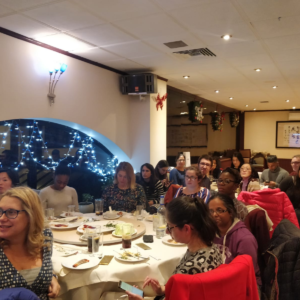
Today’s blog looks into the connections and collaborations that I have made over the last couple of months, including my first forays into the world of the CCG, the fantastic First 5 Leaders event, the National First 5 Committee meeting at the college as well looking forward to the East Midlands First 5 Conference in the new year!

I would like to title this month’s blog “Making Connections” as this has been at the centre of my discovery of all that it means to be a First 5 GP and has been the route to the successes and insights I have had over the first 2 months of this role.

The first connections made have been those that sit between myself and the CCG. Up until now, as a locum and then salaried/fellowship GP my interaction with the CCG/ICS has been quite limited.   The system has often felt confusing and complex and the mysticism surrounding why decisions are made and how they are made are starting to become clear.   I feel that this improvement in tangibility helps me to see where projects can be initiated and carried through.   This will be a topic for further blog as the complexities are quite real however, as I now discover, not impenetrable!

Other connections that have become apparent to me are that between different groups of First 5s.   I understand the term “First 5” was initially coined by the RCGP as a way to identify and bring together GPs in the early stages of the career to help provide support, nurturing and guidance as they enter the often quite daunting world of independent practice.   There are groups run by volunteers all round the country and the dedicated members arrange CPD, support, events and many other things in different areas and the First 5 community in Nottingham is thriving with monthly CPD events and a range of free events such as the upcoming second East Midlands First 5 Primary Care Conference on 11th Feb 2020.   This is being co-hosted between the Vale of Trent and the Leicester First 5 leads and together we have tried to use our experience and connections to bring together a programme tackling some of the most common issues facing first 5s.

The local collaboration for the conference has been really helpful in connecting up the dots locally but more and more I feel that I am part of a national First 5 Network which is making great strides in promoting young GPs and really forming a support and development system that really meets modern day demands.

Firstly, a trip down to the Royal college saw the RCGP leads from all over the country sit and discuss the differences and difficulties faced across the country. It is surprising to me   to see the differences between the regions and what is being offered locally, and I’m proud to say that in Nottingham we appear to be strides ahead of some other places with support for career development, fellowships, CPD and many other things (and certainly the topic of another blog!) but there is more that we can do especially in collaboration with other areas.

There are so many projects going on at present and I would like to end today’s blog with the massive success of the first – First 5 Leaders Event! This was an full day looking at harnessing the enthusiasm and creativity of the First 5s from far and wide but had been arranged by the GP Recruitment and Retention in the Midlands NHSI team.

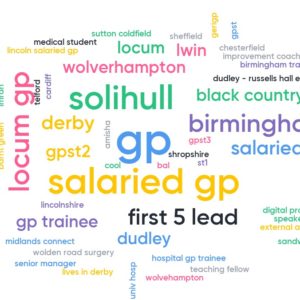
A brief look at the word cloud below will show just how far afield people came from to share their ideas, and after over 6 hours of “human design” 9 innovative projects were created, developed and pitched and will be taken forward to see what impact they can bring in our health service! This wouldn’t have been possible without the inputs from different CCGs Leads including Nottinghamshire, Black Country, Birmingham, Bedford and Northampton!

I see these collaborative events as crucial to the work of the CCGs across the country. Not only did this bring together First 5s from many different places, but it gave the leads a chance to meet and exchange ideas and has resulted in the reformation of a “First 5 Leads Network”, where we can share our successes and knowledge between us.     We have so much experience and enthusiasm to give that harnessing it all together, who knows what else we can achieve!

A Packed Ophthalmology
The backgrounds and origins of the First 5 Leader event attendees

Blog 3: Flexibility and Retention in General practice

Dr Sonali Kinra is a GP Partner at Hucknall Road Medical Centre, Nottingham and our ICS lead for GP Retention.

This is the third of her monthly blog series where she focuses on improving recruitment, retention and joy within General Practice.

This is the third in my monthly blog series as GP Retention lead for Nottingham and Nottinghamshire ICS.   It gives me an opportunity to reflect on my activities over the past month and to lay out in front of you the developments around recruitment and retention in our area.

I had my appraisal this month which I do find an enjoyable experience (no sarcasm intended). There is a useful myth-busters document on appraisal and revalidation on the RCGP website and this helpful Podcast by Dr Gandhi and Dr Zoe Norris who discuss all things tools for appraisal – for those of you who have just finished training it’s well worth a listen.

On one Friday afternoon after finishing my surgery, I listened to this King’s Fund podcast – Tackling burnout – a personal and national global crisis; you can watch this on demand. Just register with your email address here. Studies show outcomes for patients are closely linked to staff wellbeing – compassion is not a sign of weakness. When we are compassionate we connect. Don’t underestimate the importance of your coffee breaks and eating lunch together.

This month Nottinghamshire LMC also hosted its 2nd GP and Consultant networking event and I had the opportunity to open the event. If you are like me, I didn’t train in Nottingham, so for me this is the only platform which allows me to put faces to names of those working in primary and secondary care. We are working on improving discharge summaries and also raising awareness of the contractual obligations of the hospital. I am acutely aware (and rightly reminded by my GP colleagues) that one of the ways GP Retention will improve is if we work more collaboratively and reduce the   inappropriate shift of work to primary care. Going forward we will hold 2 events each year with all 3 hospitals in our system. If you wish to get involved then make contact with Phoenix programme.

I also attended the People and Culture Subgroup Board which brings together the chairs of various subgroups such as the primary care workforce group (me), medical cabinet, AHP, nursing and midwifery cabinet, HR & OD and the learning & development partnership. This was to review the subgroups of the Board to ensure we are aligned to delivery of the ICS, Long Term Plan and People Plan objectives and also discussion on governance arrangements.

We had the Primary Care Workforce Group meeting on 21 November . This is an opportunity to get monthly update from the Phoenix Programme and training hubs and we also received update on primary care networks (PCNs). The social prescribers are all in post now and going through their induction process and also getting around to meet with the practices. Ask your practice manager who is social prescriber linked to the practice – it will be good to get to know them early on. Do you know which PCN you work in? See here information on aims and priorities and demographics of different PCN as well as Clinical Directors.

We were also able to confirm that the Phoenix Programme has now received funding towards special interest/fellowship opportunities for midcareer GPs so please get in touch to find out more at info@phoenixprogramme.co.uk. They are also looking to talk to GPs who have been working in General Practice for at least 20 years and maybe considering reducing sessions/retiring. We wish to support you during your transition and also want to learn from your experience and wisdom for our current and future generations of GPs.

There are also opportunities offered by alliance of training hubs for multi-professional training and development contact them via alliance.hub1@nhs.net

Following this I attended an event on Gender and Ethnicity pay gap organised by Dr Jas Atwal @jasjitkauratwal – a GP who has recently started working in my surgery. There is a 33% pay gap between men and women working in General Practice – something I was completely oblivious to. For those interested to find out more, Jas has written 3 very useful blogs here. There’s a lot more to come in the months ahead on this.

The next day, we both gave a short introduction on the same topic to GP trainers in Birmingham and Solihull – @SabenaJ is the outgoing Associate Dean. The conference was looking at differential attainment and celebrating differences which made me ponder on the support that is there for international medical graduates (IMG). In a recent GMC report it was noted there were more IMGS that joined the register compared to UK graduates but also a large number of IMGs under 55 were leaving. It’s an area we wish to develop a better understanding and if you are interested in working with us drop me an email.

Some of you may remember that in my last blog I mentioned about Nottinghamshire women’s network. We were successful in having our first meet up and have the second one planned for 5pm 30 January 2020 (venue tbc – likely Belfry Hotel). We discussed common challenges and barriers to career progression and flexible work solutions for all irrespective of gender and also how we can empower and engage women to take on leadership roles. If you wish to be involved then get in touch with me.

I am hoping that all the sessional workforce get information about local PLTs – all the slides are available on Teamnet (you can register here). They also hold webinars and the next one is on Adult Safeguarding on 4 December 2019 – Register in advance for this webinar:  Click here  

We had the 4th in our 5 event series of Next Generation GP event – Claire Marie Thomas @drclairemarie held a workshop on the story of self and also gave us useful links on how to build your story of self, which you can find here.

Dr Carolyn Wilkins @CWilkinsOldham was asked what advice she would give to her younger self and her response will resonate with many of us:

  • Be yourself
  • Don’t be in a rush – your life is a marathon
  • Find joy every day

Many of you will be putting up the Christmas tree this week – spare a thought for those who have lost loved ones. As a practice we have decided to donate towards Anthony Nolan Trust instead of cards. Anthony Nolan is the charity that makes lifesaving connections between people with blood cancer and incredible strangers ready to donate their stem cells visit the website here.

Until next time,

Sonali

@SonaliKinra

sonali.kinra@nhs.net

Mental health support teams to launch across schools in Rushcliffe and Gedling

Mental health support teams to launch across schools in Rushcliffe and Gedling

Pupils struggling with mental health issues are set to benefit from more joined-up care and support across schools and NHS services as a new mental health support service is launched in a number of schools in South Nottinghamshire.

Mental Health Support Teams will be available to pupils in Rushcliffe and Gedling from December 2019, giving them access to help from NHS trained staff earlier and within their school environment.

Local NHS Commissioners and Nottinghamshire County Council have received pilot funding to roll out the scheme, enabling the teams to be set up in schools across Rushcliffe and Gedling to offer increased access to emotional and wellbeing support.

The teams will be staffed by mental health professionals from Nottinghamshire Healthcare NHS Foundation Trust CAMHS services and will work with children and young people with mild to moderate emotional, mental health and well-being problems.

The scheme will be launched at a partnership event today, Wednesday 27 November, which will give involved and interested organisations the opportunity to find out more about the CAMHS services and how practitioners and teachers will work together.

Initially, 43 schools will benefit from the rollout of the scheme. The Mental Health Support Teams will be operational by December 2019, and will include Cognitive Behavioural Therapy therapists, Education Mental Health Practitioners and administrator.

The team will:

• deliver evidence-based interventions in or close to schools and colleges for those with mild to moderate mental health issues;

• help children and young people with more severe needs to access the right support;

• work with and within schools and colleges, providing a link to specialist NHS services;

• and build on and increase support already in place, not replace it.

These schools will be the first in Nottinghamshire to implement and test the Mental Health Support Team delivery model, and learning from these trailblazers will inform the future rollout of the scheme across the City and County.

Dr James Hopkinson, Gedling GP and the Nottingham North and East Clinical Commissioning Group’s Clinical Lead, said: “This scheme is a great opportunity to focus on early intervention.

“We know young people and their parents and carers want to be able to access mental health services quickly and that the earlier mental health problems are identified the better the health outcomes.

“Issues like exam stress, low mood and friendship difficulties will all be tackled to help young people as they navigate school. Having mental health support teams in schools will provide additional support for well-being and mental health directly to children and young people and offer an easier and more familiar setting for them to access care when they need it.”

Councillor Philip Owen, Chair of Children and Young People’s Committee at Nottinghamshire County Council, said: “Schools play a vital role in identifying mental health needs and building resilience in young people, so we believe these teams will enhance the support already in place.

“The mental health support teams will work with children, young people and their parents and carers to help them access the right support and provide a link to specialist NHS services. They will also offer one to one and group interventions for those experiencing anxiety, low mood, friendship difficulties and behavioural difficulties.”

Dr Julie Attfield, Executive Director for Mental Health with Nottinghamshire Healthcare commented: “Any additional investment into the mental wellbeing of young people has to be celebrated. I am delighted that this support is being extended to enable more young people to benefit.”

Connected Notts offers safer, more efficient care with data sharing

Connected Nottinghamshire offers safer, more efficient care with MIG  record sharing

Sharing patient data via the  Medical Interoperability Gateway (MIG)  is boosting efficiency and helping to save lives among 1.1m people in the Nottinghamshire area.

Ninety-two per cent of staff say the MIG from Healthcare Gateway has helped them to improve overall patient care*. The MIG lies at the heart of the ever-evolving  Connected Nottinghamshire data sharing network, making vital, real-time information from 143 GP practices across six CCGs available to a wide range of NHS users including hospital doctors and nurses, social care workers and ambulance staff.

“We wanted to improve health and social care data sharing,” said  Andy Evans, Programme Director at Connected Nottinghamshire. “After extensive research, we chose the MIG in 2014 as a low cost, high value tactical solution that we could deploy easily. We can summarise complex data from any source and share it widely to other systems via the MIG very quickly. We are now making information from over 90% of GP patient records available, compared to 15% in 2015.”

Connected Notts first target was to make patient records, including a supportive care dataset, available for acute emergency care and out-of-hours clinicians.

Shared medication data via the MIG was directly responsible for saving one overdose patient’s life and has also helped GPs and A&E doctors to spot attempts to obtain multiple medications – preventing unsafe duplicate prescribing.  Their evaluation estimates record sharing has taken two minutes off every consultation (adding up to over half an hour in each clinician’s day) and reduced hospital admissions by one per clinician per month.

The major benefit has been to make accessing medical histories quick and easy for clinicians, letting them make better informed decisions about assessing, prescribing, referring and planning care for patients. The additional dataset supports decisions around end of life care and treatment while recognising a patient’s wishes and preferences.

Dr Anita Bloor, Senior  Medical Advisor at out-of-hours  and urgent primary care  provider NEMS, said: “Access to live primary care records via the  MIG gives our doctors and other out-of-hours  clinical  staff the vital information they  need to make safe, effective and appropriate decisions. We now look at the  patient’s GP  record in almost every case we manage and, if it’s not available  for some reason, it’s like having one arm tied behind your back. Immediate  access to GP records  can also prevent unnecessary  hospital  admissions, which  is particularly important with frail elderly people.

Dr Anita Bloor and Andy Evans

The MIG worked so well that within two years of its launch in Nottinghamshire, it was enabling record sharing across many healthcare organisations including out-of-hours services, multiple hospitals, 111 staff, GPs, community carers, mental health workers and many others. Via the Midlands Accord, CN has crossed regional borders to share data with organisations including DHU 111 and the East Midland Ambulance Service.

Giving every GP the background data they needed to handle an unexpected death was another priority. If they didn’t know the patient or hadn’t seen them within the last 14 days, GPs previously had to opt for a post-mortem. Evans said the MIG had been “transformational” in changing local policy in this area.

“The MIG saves time otherwise spent contacting GPs and other trusts to obtain information,” said  Leanne Alder, Research Radiographer at Nottingham University Hospital.  “We can more easily check which other medications patients are taking for any potential drug interactions and it also stops patients getting annoyed that GPs and hospitals don’t talk to each other.”

The MIG is also making information from Nottinghamshire’s GP Repository for Clinical Care (GPRCC) more widely available to organisations like 111. The GPRCC analyses data from GP, community, mental health, acute provider and social care systems to produce information such as risk scores for COPD and an Electronic Frailty Index.   Sharing valuable GPRCC intelligence through the MIG will allow clinicians to better prioritise response to acute workflows and guide patient care.

Offering sophisticated and flexible “integration technology”, the MIG currently connects 4000 health and social care providers within the UK, sharing a total of 30 million patient records. More are being added all the time.

“We are delighted that the MIG employed originally as a tactical solution is now integral to the care provided to residents of Nottinghamshire,” said  Liam King, Commercial Director at Healthcare Gateway. “There are many real quantifiable benefits in time-saving, efficiencies and a more positive experience for patients and clinicians.”

* [Independent benefit analysis conducted by NHIS direct with clinical staff using MIG]