New Enhanced Health in Care Homes Service for Broxtowe
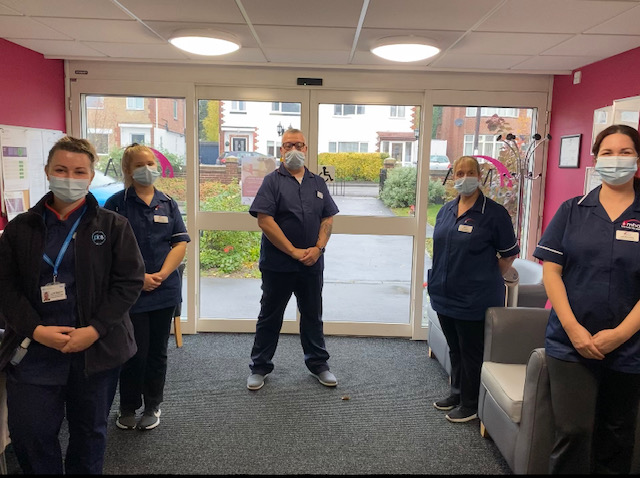
Laurie Chadburn (Left) Mark Griffin (Middle) with Victoria, Julia & April, Senior carers at Queenswood care home following Training session for full observations and early recognition of deteriorating persons.

Incorporating the NHS Long term plan, and in response to the Covid-19 crisis and its impact on care homes, a new team has been assembled in Nottingham West Primary Care Network to support care home staff, residents, families, primary care and community services.   Laurie Chadburn,  Clinical Care Home Lead in the Enhanced Health in Care Homes Service  explains how the new team works…

Since coming into post in September as Clinical Care Home Lead for the Enhanced Health in Care Homes Service (EHCH) at PICS, I have had the pleasure of introducing myself and the new service to the nursing and residential homes across the Nottingham West PCN patch.

It was really important to have these face-to-face and video call discussions to discuss how we can work together and how we will be supporting the care staff, residents, families and community services to provide a specialist clinical response. This service is specifically designed to improve the access to the health services received by residents in care homes and integrate and streamline community referral pathways.

The EHCH team, which will be complete mid-November, is made up of a Registered Adult Nurse, a Registered Mental Health Nurse, a Physiotherapist, three Occupational Therapists, a Dietician, three care home administrators our teams will also have a close working relationships with the six PCN Pharmacists already in post.

We will also continue to work closely with Jess Waterhouse and Wendy Berridge who have done incredible work with their Respect project across all NW care homes.

So what will be doing? Well, our remit will include weekly ‘home rounds’ available to every care home on the patch to reduce the care home workload for GPs and Advanced Nursing Practitioners to improve the access to health services for residents.

We will also be making direct referrals to other teams, for example Community Nursing, Therapy, Dementia Outreach, Community Matrons etc.

The integration of community services working closely with PICS’ specialities will be pivotal in ensuring the residents in care homes receive an equitable service across the patch – this can only be achieved by a multi-disciplinary team approach.

So how does EHCH work?

All residents newly discharged from hospital or admitted to the care home from their own homes will have a Clinician from the EHCH team complete a full holistic assessment within seven working days.

This will identify any requirements for specialist community services and will support the GPs in providing medical care, when required. We will develop a care plan for the resident and our goal is that all residents will have a holistic assessment completed which will also be shared with community teams to improve referral processes and reduce duplication of workload, thus improving the patient journey.

Mark Griffin, a Registered Mental Health Nurse, and I will be working closely together as the Clinical Leads already in post and are offering training and educational support to ensure the staff feel competent and confident to help reduce hospital admissions and ensure their residents receive the best possible care and ‘at home’ treatment available to them.

We recently spent the morning with Queenswood care home in Beeston to provide a training session on blood pressure monitoring and completing documentation to promote early recognition of a deteriorating patient and Sepsis risk. This was very well received (see photo) and they are looking forward to further training opportunities.

We’ve had a great response from care home staff and our colleagues across community services, GPs, PICS, the CCG and across the local health and care system and this has really encouraged us to progress and lead with the implementation of this service.

We are at the forefront of change and to be driving the integration and collaboration to improve the patient experience is very exciting for us all.

Listening to our citizens and patients during the coronavirus pandemic

It became clear in the spring of 2020 that the impact of the coronavirus pandemic on the way that health and care services would be delivered was going to be deep and far-reaching. In order to protect patients, citizens and staff from the impact of the disease, a considerable number of changes were made to the way health and care services were accessed. This included making radical changes, not only to the way in which services were delivered but what was delivered where.

In addition, during this period many significant and detailed announcements were made by Government regarding the activities in wider society  which included  considerable restrictions on those with long-standing and serious health conditions.

Whilst many of these restrictions and some of these changes have subsequently been reverted,  and to some degree society  has  returned to a sense of normality, there are many circumstances where the changes to health and care services might need to remain in place for many months, perhaps forever.    In addition, the  impact of the Government’s wider actions to control the pandemic  has  had an impact on our population’s health and wellbeing and the way they use NHS services.

When these changes are reviewed and evaluated it is important that alongside the expert clinical and managerial,  as well as financial considerations,  there is a clear set of feedback from patients and citizens to inform that evaluation.  Therefore NHS Nottingham and Nottinghamshire Clinical Commissioning Group (CCG) and Nottingham and Nottinghamshire Integrated Care System (ICS) have collaboratively worked together to analyse and report on the impact of these changes throughout the pandemic period.

The overall ambition of this public insights project was to;

  1. Understand people’s views of the changes made, even if they are not directly affected
  2. Understand the tolerance of the population for keeping the changes made
  3. Understand the impact of changes on the people directly affected
  4. Understand the impact of keeping changes on the people directly affected
  5. Understand the impact of changes on groups who are vulnerable and face barriers to accessing services as a result of  the coronavirus pandemic.

For more information and all the details  click here.

Pregnant mum with twins explains importance of getting the flu vaccine during pregnancy

A pregnant mum from Nottingham has spoken about the importance of getting the flu vaccine during pregnancy.

Keisha Reid, who is 19-weeks pregnant with twins, decided to get the flu vaccine at her local GP when she knew that vaccinations were taking place.

The 34-year-old health visitor, who works all over Nottingham city, said she decided to get the vaccine as she knew about the health risks of catching the flu.

She said: “I got the flu vaccine because it is the best protection for me and my twins. If I caught the flu it could be very dangerous but now I know we are protected and it only took two minutes.

“I would urge all women to get the vaccine as there is no reason not to. It is safe, it is tested and it is so quick and easy to get done. I think the moment anyone does their research on why they should get vaccinated when pregnant they get it done; once you know the risks you don’t want to take the chance.”

Women are at higher risk of complications from flu during pregnancy because they have a weaker immune system. As a result, the NHS offers pregnant women a free flu vaccine due to likelihood of it developing into a more serious illness such as Bronchitis or Pneumonia. In rare cases, flu can lead to miscarriage, stillbirth and even the death of the mother.

Dr Husein Mawji, a GP at the Victoria and Mapperley Practice, said: “The number of pregnant women taking up the offer of the free flu vaccine is still quite low in Nottingham and Nottinghamshire, which is worrying. Pregnant women are at a much higher risk of developing serious complications from the flu affecting them and their baby, including a higher risk of their baby being born prematurely, with a low birthweight, or even stillbirth. I would urge all pregnant women to think very seriously about getting the vaccine as it is the best protection for you and your baby.”

Pregnant women in Nottingham and Nottinghamshire can get the free flu vaccine from their GP, a local pharmacist or at a hospital.

For women receiving maternity care from Nottingham University Hospitals they can get the vaccine at the Queen’s Medical Centre or Nottingham City when they go for a scan or at drop-in antenatal sessions at:

 · Queen’s Medical Centre antenatal clinic: 8.30am – 4.30pm Monday – Friday

 · Nottingham City Hospital: 8.30am – 4.30pm Monday – Friday

For pregnant women who are receiving maternity care from Sherwood Forest Hospitals (SFH) they will be offered the flu vaccination at the antenatal clinic at the time of their 12 or 20 week scan. The vaccine will available at both the King’s Mill and Newark Hospital sites.

For more information please visit:  https://nottsccg.nhs.uk/flu-guidance/the-flu-vaccine-in-pregnancy/

Harnessing Housing Support: Nottingham Housing to Health

The Nottingham Housing to Health (H2H) project provides fast-track housing solutions for patients in hospital and in the community through joined up working across Nottingham and Nottinghamshire.

The H2H service is a joint project between Nottingham City Homes (NCH) and NHS Nottingham and Nottinghamshire Clinical Commissioning Group (CCG). The partners work together to identify patients in hospital and in the community who are living in poor or unsuitable accommodation that is negatively affecting their health. The aim is to provide fast-track housing solutions to rehouse them into good-quality social housing

Delays in transfer of care have been identified as a significant issue for the NHS, placing additional burden on the health service, as well as putting patients’ health at risk. By working together across the ICS to provide fast-track housing solutions for patients in hospital and in the community, the project has been able to deliver financial savings to the health service, local authority and housing provider.

The project has also improved the health and wellbeing of patients and their carers, enabling them to live independently and reducing their ongoing use of health and care services.

The service has helped avoid 23,000 days of delayed transfers of care from the NHS or social care facilities; and the pressure on hospitals has improved because re-admissions per person have reduced from four to two per year following housing support.

As a result of the service, 98 per cent of patients now feel safe in their home.

The report provides very strong evidence of the benefits that can be achieved through partnership working to the people of Nottingham and describes the practical steps that helped it to happen.

Read the full report here.

Co-mentoring opportunity across Nottingham City Integrated Care Partnership

The world is changing and how we work in the future is changing alongside it.

Nottingham City Integrated Care Partnership (ICP) is leading the change and we are looking for 14 frontline colleagues from different local organisations to help start to shape this through a co mentoring scheme.

Are you interested in a new challenge and opportunity?

We are delighted to be offering, across the ICP, our first co-mentoring scheme and are seeking 14 front line colleagues to participate in this exciting opportunity. You may be working in any role and probably will be working in one of the following organisations/services:

  • Primary care
  • Community
  • Acute care
  • Mental Health
  • Community voluntary sector
  • Social care
  • Commissioner or provider

The aims of this programme will be to:

  • Share knowledge and expertise across the ICP
  • Widen awareness of roles and responsibilities of the organisations that make up the Nottingham City ICP

You will need to commit to attend a virtual briefing session on the  21 December 2020 at 1230 hours  for 90 minutes which will provide an introduction into co-mentoring and how the programme will run. After that you will be introduced to your co-mentor and will be expected to meet virtually at a time and date to suit you both, but will agree to meet a minimum of twice before the end of March 2021. Therefore, you will need to commit to a minimum of approximately 4 hours to participate in the programme.

We welcome all applications from across our staff groups in the ICP.

If you are interested please complete the application form and email it to  Tracytyrrell@nhs.net

The application form can be found here.

Enhanced Care Response Team: a ‘pioneering’ response to support care homes during the coronavirus pandemic

More than 40 nurses were redeployed to help care homes in Nottinghamshire in a ‘pioneering’ response to the coronavirus pandemic which resulted in partners across the system sharing best practice and information.

When the coronavirus pandemic took hold across the region care homes were bombarded with daily changes in information which staff had to deal with whilst also coping with increased deaths and the trauma caused by the virus.

In response to this, NHS organisations, the local council and care home managers came together under the leadership of the Nottingham and Nottinghamshire Integrated Care System (ICS) to launch the Enhanced Care Response Team (ECRT) to provide clinical support to care homes in the area.

The system-wide team of support included help from local authority experts such as public health and NHS experts in infection control along with nurses from the local hospital.

Rosa Waddingham, chief nurse at NHS Nottingham and Nottinghamshire ICS, said: “At the height of the coronavirus pandemic Nottingham and Nottinghamshire’s care homes were supported by partners across the system who provided a pioneering response to the changing environment and the pressures faced to the health and care sector.

“The response to the pandemic within care homes was initiated by a personal letter to all care homes offering a range of support and asking what they required. This led to the launch of the Enhanced Care Response Team (ECRT) – a time limited support offer from the NHS and local authority. The system-wide response allowed care homes to be supported, and most importantly feel safe, at what was an uncertain and frightening time for staff and residents.”

The ECRT response included help and support in a number of different ways. The main purpose was to provide support to care homes, provide clear information for best practice and help with training.

The team did this by:

· Carrying out a daily central briefing collated and disseminated and a bi-weekly webinar on various subjects, often with doctors and nurses available to give advice and information.

· Compiling a toolkit of best practice which is regularly updated. Training from the toolkit has been delivered to 368 homes and has been downloaded more than 3,000 times.

· Offering and/or delivered PPE training within 14 days to 100 percent of care homes

· As part of the ECRT response more than 40 nurses were redeployed to go out to care homes, support and offer training on the toolkit.

Kristian Morgan, manager at Beeches Care Home in Mansfield Woodhouse, added: “It has been a particularly difficult time for care homes this year and the ECRT has been very useful in disseminating skills and training. When coronavirus first started there was a worry that we would be left on our own to deal with it but that isn’t what happened. We were given the opportunity to be trained in infection control and PPE which was essential in keeping our resident and staff as safe as possible. We appreciate the support which has given us the confidence to know that we are equipped and have everything we need to do a good job. Our residents were also able to feel supported and safe and that is what our work is all about.”

The successful system-wide approach in supporting Nottinghamshire’s care homes has now been extended in order to support care homes throughout the pressured winter period including support for the possibility of a potential second surge and in providing flu vaccinations to patients.

Margret Abbott – Health Inequalities in Nottingham City

In the midst of the first peak of the COVID pandemic, I was appointed as Clinical Lead for Health Inequalities for the Nottingham City ICP. This role was not created in response to the health inequalities highlighted by the pandemic, but because the inequalities in health outcomes in Nottingham City have long been recognised. The pandemic has sadly made worse and more visible what were already very real differences in health and wellbeing between the diverse communities within the City.

I have been a GP in Sneinton/ St Anns for over 30 years. There I have seen at first hand the struggles local people have with low income, poor housing, unemployment, barriers to access care, difficulties when English is not fluent, and low education attainment levels. I have also seen the incredible strength, resilience, flexibility, support and community spirit of our citizens and voluntary and statutory services. I am both pleased and excited to be involved in the City ICP where services and citizens can come together to address some of our most pressing problems that affect health and wellbeing.

Most inequalities in health outcomes experienced by our citizens (such as the wide differences in life expectancy and years lived in good health) are related to what are called the wider determinants of health i.e. income, employment, housing, environmental factors like pollution and access to green spaces. So, it is vital these areas are addressed by our ICP.

Working together, across agencies, improvements can be made to improve other drivers of health inequalities. Things like barriers to accessing care, and promotion of healthier habits like reducing smoking, having a healthy diet, taking exercise and looking after your mental well-being all make a difference. By increasing the knowledge and cultural awareness of our health and social care workforce we will improve citizens experiences and create easier access to services.

Since my appointment to post I have been linking with various forums related to vulnerable groups who experience the poorest health outcomes in our society. So far, I am directly involved in work related to homelessness, those experiencing severe and multiple disadvantage, migrants (including asylum seekers and refugees), carers, people with long term mental health conditions and those with a learning disability. There has been some really great work in relation to issues for these vulnerable groups which it has been a privilege to witness and be a part of.

One project I would like to highlight here is the work with rough sleepers during the ‘Everyone In’ government initiative. The requirement to provide all those who were homeless with accommodation during the initial weeks of the lockdown was met in Nottingham with an amazing collaborative effort. Collectively we were able to provide the very best wrap-around services, from health, social care, housing, voluntary agencies, and community groups. As a result, many, previously unengaged, homeless people were supported to get help with mental ill health, substance misuse or other issues and were enabled to move into permanent accommodation. This work has been recognised nationally as a particularly effective collaborative response. The project did not ended there as the multi-agency group has continue to apply the lessons learned from this project by developing ongoing collaborative wrap-around support to those who are still, or newly homeless.

Further to the work with vulnerable groups I am also supporting the current ICP programmes relating to care leavers, health inequalities experienced in BAME communities, reducing smoking, and improving flu vaccination uptake. I hope to share more detail of this great work happening across Nottingham in future blogs.

If you would like to know more about health inequalities in Nottingham please contact me.

Local GP invites Broxtowe residents to discuss health and care priorities at ‘Broxtowe Together’ event

Local GP invites Broxtowe residents to discuss health and care priorities at ‘Broxtowe Matters, a Primary Care Network engagement event

Dr Tim Heywood, Clinical Director for Nottingham West Primary Care Network (covering Broxtowe), is inviting people who live and work in the Borough to join him at Broxtowe Together, a digital engagement event to discuss priorities for health and care in the area.

The event, which will take place on Zoom between 11am and 1pm on Thursday 19 November, will be led by Dr Heywood, who also works as a GP in Eastwood.

The Nottingham West Primary Care Network (PCN) works across health and care organisations, local councils and communities in Broxtowe to support the integration of services and help local people live happier, healthier lives.

PCNs bring together GP Practices with a range of local organisations and groups, including community services, social care and the voluntary sector, to provide coordinated health and social care to their local populations.  The networks involve local communities to ensure they are delivering the right services for local people.

Nottingham West PCN covers the GP Practice areas in the Broxtowe borough and is one of six PCNs which make up the South Nottinghamshire Integrated Care Partnership.

The PCN is divided into three neighbourhoods   – Beeston, Eastwood and Kimberley and Stapleford.

Interested residents and health and care workers in the area can sign up at:   https://www.eventbrite.co.uk/e/124529660567

If you come along to our event, you will:

  • Learn more about the Primary Care Network
  • Join the conversation about how we work together across organisations and community to improve life for people living in Broxtowe
  • Meet and discuss the health and wellbeing needs of local people with local leaders.

Watch Dr Heywood talk about why you should join us.

People attending the event will be asked to review the PCN priorities, make sure they continue to be fit for purpose and look at how participants can get involved with making sure we can plan well for the future.

Dr Heywood says: “This event is a fantastic opportunity to get involved with the development of integrated services in Broxtowe. I’m keen to talk about our priorities with different organisations and local people and get everyone involved in the development of our Primary Care Network.

“The event is a key point where we’re spreading the net as widely as we can to invite as many people as we can to come along and talk to us and talk to each other to see if this is something they want to be part of.

“We really want to engage with people so they are genuinely involved in how their local services develop and how we join up care. So, if you have the time and you want to get involved, I look forward to talking to you.”

People who are interested in finding out more about the PCN and getting involved with shaping services can sign up at:  https://www.eventbrite.co.uk/e/124529660567

Blog 12- Vulnerability -The greatest measure of Courage

Dr Sonali Kinra is our ICS lead for GP Retention. This is her monthly blog series where she gives an insight into her role and more.

We are all feeling vulnerable, overworked and tired. The news headlines last week were damaging to General Practice morale at a time when we should be looking out for one another- if you have been affected by this then please reach out to Nottinghamshire LMC or Practitioner health programme or drop me a line. It’s ok to not be ok.

I chaired Primary care workforce group meeting in the last week of August. We received updates from Nottingham Alliance of Training Hubs (NATH) on the training needs analysis collated across GP practices and PCN and training around mental health awareness features right at the top. We discussed progress made on GPN Ten point plan with a further detailed update this week. PCN nurse leadership CARE programme had its launch event on 8th Sept with nurses participating across PCN, community and care homes. A further networking meeting is planned for 14th October to bring together new to practice nurses who completed fundamental programmes 19/20, Digital nurse champions , SONNET programme and CARE programme nurses to share their experience on common platform as well as discuss opportunities to work together

There is recognition of the challenging and isolating role of the senior pharmacist providing leadership to the pharmacists in PCNs. NATH is working with the senior pharmacist leads across the 3 federations to develop bespoke plan for multi-professional supervision and help embed them into the teams. Phoenix programme (PP) also gave an update on its various workforce schemes and informed us that we have been approved for 5 places on trailblazer scheme- please get in touch if interested to join the scheme and/or become part of Deepend GP group. New to Partnership programme has been agreed in collaboration with Derbyshire GP taskforce and Vale of Trent RCGP has accredited the course- we are awaiting for release of dates. The New to Practice implementation group await finer details from regional NHSE team around funding on New to practice scheme and Supporting Mentors Scheme. PP continues to provide virtual CPD session and support and we are also in the process of leading discussion around Next generation GP Programme

We held our first Nottingham Racial Equity, diversity and inclusion symposium on 2nd Sept- it is available to view here. It was an insightful event where we had 160 people across the Nottinghamshire health and care system joined us to share their experience, hear from Prerana Issar and Marie Gabriel and commitment from Chief exec of all organisations within ICS to sustainable change. The planning team is reviewing the feedback and Lyn Bacon will be taking a set of actions to Nottinghamshire ICS board and I will share these with you soon

NHS digital general practice data collated 30th June 2020 continue to show downward trend in GPs with a very slight increase in FTE nurses. Data is now also being published on PCN workforce and we continue to get more details while planning ahead for 20/21 and beyond. I am also continuing in my discussion with NHS leadership academy on sponsorship programme for women and expressions of interest are being invited for Ready Now Programme

I was elected to RCGP Council in recently held national election- many thanks for your support. I officially start in the role in November but had a chance to observe the council in action on 18th Sept. Rich discussions on health inequalities, BAME action plan, Appraisal Reboot and Sustainable General practice.

This is my 12th blog having completed 1 year in this role- it has been a learning experience for me and hopefully has helped keeping you informed

Ending with a Quote from Brene Brown “Vulnerability is not winning or losing; it’s having the courage to show up and be seen when we have no control over the outcome. Vulnerability is not weakness- It’s our greatest measure of Courage”

As always

Sonali
@SonaliKinra